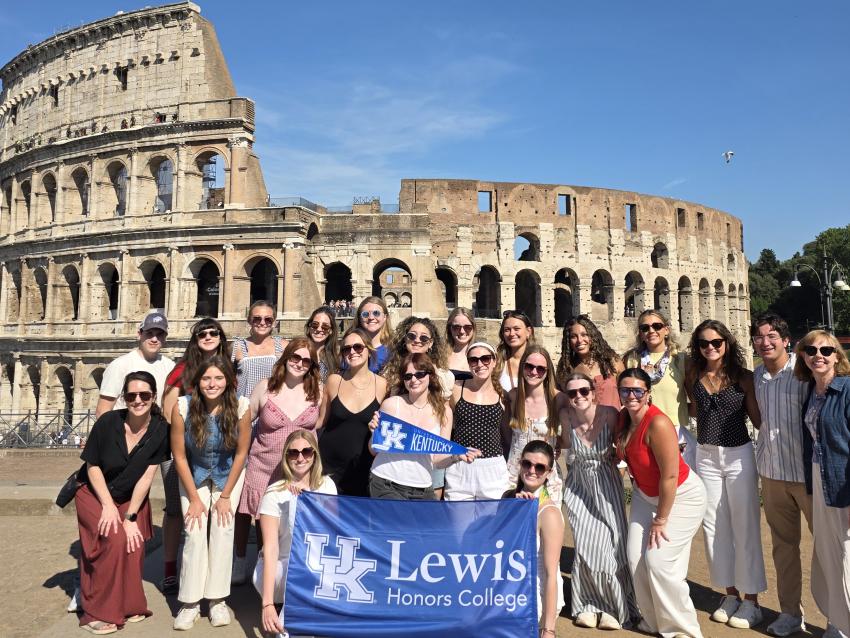
Record participation reflects growing demand for honors education abroad programs
LEXINGTON, Ky. (July 15, 2026) — A record 60 Lewis Honors College students participated in four honors faculty-directed education abroad programs this summer, a 54% increase over last year. Overall, a record 250 honors students studied abroad through a variety of programs during the past academic year.
In the four honors faculty-directed programs, students traveled to Ecuador, England, Greece, Italy and Scotland to study sustainability, leadership, writing and distilling.
“Leading these courses is incredibly rewarding because students grow so much,” said Pearl James, Ph.D., associate dean of academic affairs. “They are out of their comfort zones in terms of language, food, surroundings and experience. But they rise to the challenges and they gain confidence over the course of the time abroad.”
Emalie Tackett, a rising senior who traveled to Greece and Italy, agreed.
“As a first-generation college student from Eastern Kentucky, this opportunity broadened my perspective, strengthened my confidence and deepened my appreciation for different cultures,” she said.
Tackett participated in “The Art of Noticing: Contemplative Travel Writing in Greece and Italy” led by Lewis Lecturer Julie Boutwell-Peterson, Ph.D., and supported by Chelsea Brislin, Ph.D., honors faculty and Gaines Center for the Humanities associate director. The course sought to bring history to life while giving literature new meaning, according to Boutwell-Peterson.
“I love how history comes alive as we walk among the ancient ruins and how poems take on whole new meanings when read aloud in the streets of Rome or at the foot of the Temple of Apollo,” Boutwell-Peterson said. “The world is our classroom.”
For Adam Hassoun, a rising junior who traveled with James on the “Tropical Ecology and Sustainability in Ecuador and Galapagos” program, his education abroad “classroom” focused on the environment and conservation.
“I learned a lot about how I can travel more sustainably, whether that is not staying at chain hotels, or just being mindful of my own AC and water usage,” Hassoun said.
He also felt that his exposure to a new culture would help his career aspirations to become a genetic counselor.
“Cultural competence and the ability to work with people of all backgrounds is so important,” Hassoun said. “This [experience] will make me a more empathetic provider when I hit the workforce.”
Sally Foster, assistant dean for student engagement and Center for Personal Development director, designed the “Scotland: Interdisciplinary Projects in Distilling” program to give students hands-on exposure to careers in the distilling industry. Foster’s background in career development gave her the insight to leverage the partnerships the James B. Beam Institute has in Scotland as well as their support of the university’s undergraduate certificate in distillation, wine, and brewing. “Our students are able to collaborate with employers in the Scotch whisky sector while learning about the multitude of career paths that intersect within the industry,” Foster said.
Rising sophomore Roxanne Hensler worked with three other UK students to partner with the Scotch Whisky Research Institute.
“My research project helped develop my professional communication and data modeling skills, which will be very beneficial for my marketing major,” Hensler said.
Another skill that rising senior Treanna Bridges learned was time management.
“Balancing distillery tours, cultural excursions, and work on our interdisciplinary project required me to plan each day effectively, stay focused, and make the most of every opportunity while still enjoying the experience,” Bridges said.
Education abroad programs also allow students to forge lifelong friendships.
“Though it was scary going to a foreign country with a group of people I didn’t really know, I came out of the trip with so many new friends and amazing memories,” Hassoun said.
To develop a faculty-directed education abroad program, instructors partner with the UK Education Abroad and Exchanges office to invest in scouting locations, building local partnerships, preparing coursework and recruiting students.
Despite the time and effort necessary to offer education abroad programs, “it’s worth it,” said James, who has led experiences focused on sustainability to Costa Rica for two years, and most recently to Ecuador in June.
Making these transformative experiences accessible is also a priority for honors faculty. To alleviate some of the costs associated with education abroad programs, Laura Bryan, Ph.D., the T.G. Lewis Faculty Scholar in Organizational Behavior; and Lewis Lecturer Sherelle Roberts, Ph.D., secured a $40,000 grant from the University of Kentucky’s Women & Philanthropy Network. The funding reduced the cost for all 18 students participating in the “Leaders of a Global Society: Great Britain and Beyond: Supporting an Intensive Leadership Experience Abroad.” James enlisted the Student Sustainability Council to support the students attending the Ecuador program. Other students benefited from supporters of the Lewis Honors College through the Kate Johnson Scholarship Fund, the James and Carolyn Halladay Fund for Education Abroad, the Geoghegan Global Citizen Endowment Fund, and the Purcell Fund.
Rising junior political science major Karmen Parker appreciated the opportunity to study British leadership where history unfolded.
“What makes British politics so interesting is the implantation of the royal family hierarchy that has dated back centuries,” Parker said. “Through this study abroad trip, I was given the opportunity to learn about a vast number of British leaders and how their leadership skills impacted history.”
With record participation and expanded funding making education abroad more accessible, honors faculty are already planning next summer’s programs, continuing to provide honors students opportunities to explore the world while preparing for careers and lives of leadership.
“I love leading these trips because I can provide students with once-in-a-lifetime experiences to places that few have the opportunity to visit, where they can encounter people, cultures and histories that are incredibly fascinating,” said Senior Lewis Lecturer Ryan Voogt, Ph.D., who is planning a return to Hungary and Romania.
Parker said she valued the opportunity to broaden her comfort zone.
“This study abroad trip changed my future for the better,” Parker said. “It made me realize that the sky is the limit, and there is so much more out there apart from your personal little bubble.”