UK welcomes UCLA political scientist to explore TV advertising’s role in elections
LEXINGTON, Ky. (Sept. 22, 2026) — Campaign advertisements are nearly impossible to escape during an election season. But what makes some ads memorable? Why do campaigns keep spending heavily on television advertising in an increasingly digital media landscape? And, perhaps most importantly, do campaign ads actually change voters’ minds?
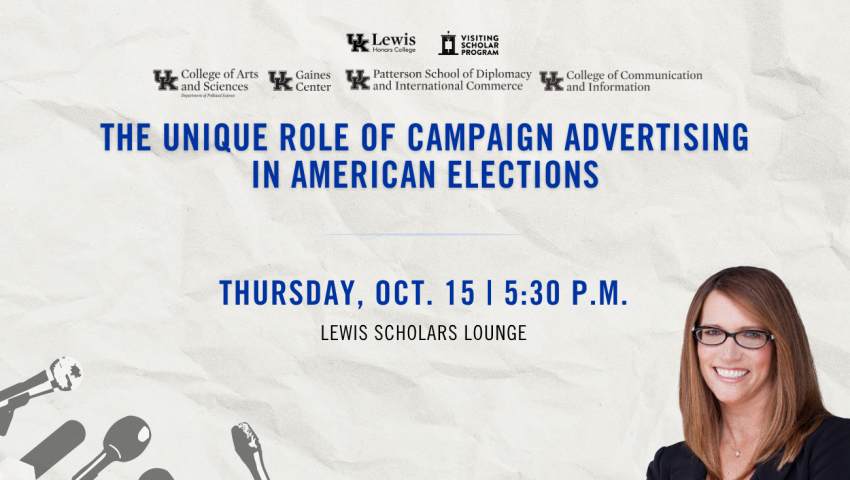
Lynn Vavreck, Ph.D., the Marvin Hoffenberg Professor of American Politics and Public Policy at the University of California, Los Angeles, will explore those questions during a public lecture at the University of Kentucky Lewis Honors College, 5:30 p.m. Thursday, Oct. 15, in the Lewis Scholars Lounge.
Vavreck will present “The Unique Role of Campaign Advertising in American Elections” as part of the Phi Beta Kappa Society’s Visiting Scholar Program. The event is sponsored by the Lewis Honors College, the UK’s Alpha Chapter of Phi Beta Kappa, the College of Arts & Sciences Department of Political Science, the Patterson School of Diplomacy and International Commerce, the College of Communication and Information, and the Gaines Center for the Humanities.
During the lecture, Vavreck will examine why television advertising remains a key campaign tool and what research reveals about its influence on voters.
“Advertisements are a unique form of communication because they combine what you see, hear and read simultaneously,” Vavreck said. “The effect of an advertising advantage is small in something like a presidential election, less than a point in most cases.”
Even when the effect is small, Vavreck said campaigns have reason to continue advertising.
“The effects, albeit small, decay rapidly so you have to keep up the pace.”
Vavreck also will give attendees some tools for decoding campaign advertisements and apply those tools to several influential examples from American political history. The advertisements span more than seven decades, beginning with the first foray into broadcast campaign advertising in 1952 and extending through the 21st century.
For Michael Rohs, a 2026 honors alum who is interested in community-based activism and voter motivation, the lecture offers an opportunity to connect Vavreck’s research with his own work.
“In my research, I try to find ways to get people more involved in activism for positive social change, so it is important to learn more about voter motivation, especially how young people may be motivated to vote,” Rohs said. “Through attending this talk, I hope to learn more about the empirical evidence behind the impact of television ads in today’s socio-political landscape. Additionally, hearing from Dr. Vavreck will help expand the elements I evaluate when trying to develop new projects working with communities across Kentucky.”
This lecture is free and open to the public. In addition to her public lecture, Vavreck will meet with three different classes.
Vavreck’s research focuses on campaigns, elections, public opinion, advertising and political communication. She studies whether political messages affect voters and election outcomes and has conducted advertising field experiments, large-scale surveys and research on media exposure.
Vavreck is the author or co-author of six books, including “The Bitter End: The 2020 Presidential Election & the Challenge to American Democracy” and “Identity Crisis: The 2016 Presidential Campaign and the Battle for the Meaning of America.” She is also a contributor to The New York Times and a recipient of the Andrew F. Carnegie Award in the Humanities and Social Sciences.